
Compass Clarity & Decision Program for Adolescents (16–19)
Many teenagers face important life decisions before they truly understand themselves.
Compass creates space for them to slow down, reflect, and develop a clearer sense of direction.
The thinking skills they develop during the program will support their decisions for years to come.
Program Compass
A 12-week group program helping teenagers understand themselves more clearly and approach important decisions about their future with greater confidence.
Cena programu: od 14 900 Kč
Many teenagers appear successful on the outside
They have good grades.
They participate in activities.
Everything seems to be working well.
Yet internally they often feel:

- uncertainty about their future
- pressure from expectations
- confusion about many possible paths
- fear of making the wrong decision
Many parents recognise this moment.
Their child is capable and intelligent, yet unsure about which direction actually makes sense.
Questions many teenagers begin asking
What do I actually want to do with my life?
How do I know if I’m choosing the right university?
Am I deciding for myself or because others expect it?
Why do I feel pressure even when everything seems fine?
School prepares students to perform. It rarely prepares them to make complex life decisions. Compass creates space where teenagers can pause and think differently.
FORM
Why a group program works well
Many teenagers discover one important thing: They are not the only ones thinking about these questions. In a group, they often hear for the first time that others are facing similar uncertainty.
New perspectives through discussion
Teenagers hear how others think — and that alone opens up new ways of thinking.
The realisation that uncertainty is normal
In the group, they hear for the first time that others face the same uncertainty.
Opportunities to learn from how others think
Hearing how others think expands one's own ways of seeing things.
A safe space to share thoughts openly
Open discussion in a small group — without judgement and without pressure.
Groups remain intentionally small: 8 - 10 participants. This allows a balance between discussion, reflection and individual space.
What participants gain
What participants often gain from the program?
After 12 weeks, most teenagers gain a clearer sense of direction, greater confidence in decision-making, and the ability to think about their future without feeling overwhelmed.

A clearer sense of direction
They begin to understand what genuinely interests and motivates them.

Greater confidence in decision-making
They learn how to evaluate options thoughtfully instead of reacting to pressure.

Less anxiety about the future
When their thinking becomes clearer, the pressure around important decisions often decreases significantly.

Greater independence in thinking
They develop their own perspective rather than simply reacting to expectations from others.

More constructive conversations with parents
When teenagers understand their own reasoning better, conversations about the future tend to become calmer and more productive.
REAL-LIFE SITUATIONS TEENAGERS OFTEN FACE
The following simplified examples reflect questions teenagers frequently bring into coaching conversations. Names and details are changed for privacy.
Too many possible options
A student with strong grades has many university options available.
From the outside it seems like an advantage, but internally it can create pressure and confusion about which path actually makes sense.
Instead of clarity, the result can be paralysis.
Expectations from family vs personal direction
A teenager may feel strong expectations to follow a particular academic path.
At the same time, they may feel drawn to something different but struggle to understand whether that interest is serious or just curiosity.
Loss of motivation despite strong abilities
A student who has always performed well suddenly begins losing motivation.
This is often not about ability. Sometimes it simply becomes unclear what all the effort is actually leading toward.
When inner direction is missing, performance alone is no longer enough.
Feeling behind compared to others
Many friends may already seem confident about their future plans.
Some have chosen a university, some a field of study, some a plan to go abroad.
When someone is still unsure, they may start believing they are somehow behind or doing something wrong.
Social pressure and relationships
Sometimes the challenge is not only about university choices.
Teenagers may also be navigating friendships, expectations from peers, and questions about their own boundaries and identity.
And that, too, is part of deciding who they want to be and how they want to live.
The program lasts 12 weeks and is divided into three phases.
Each phase builds on the previous one — from self-understanding through clarity to independent decision-making.
Understanding yourself
Many teenagers begin noticing patterns in their thinking they had not recognised before.
Clarity and direction
Gradually, uncertainty becomes a clearer set of possibilities. Participants learnt to distinguish between personal interests and outside expectations.
Ownership and confidence
Participants develop greater confidence in their thinking, the ability to explain and stand behind their decisions and a framework for future decision-making.
WhatsApp group
Each group has its own WhatsApp group. It serves to:
- connect participants
- share short reflections between sessions
- communicate organisational information
Participants are added to the group about one week before the program begins.
The group will also contain practical information about the program and location.
Program format
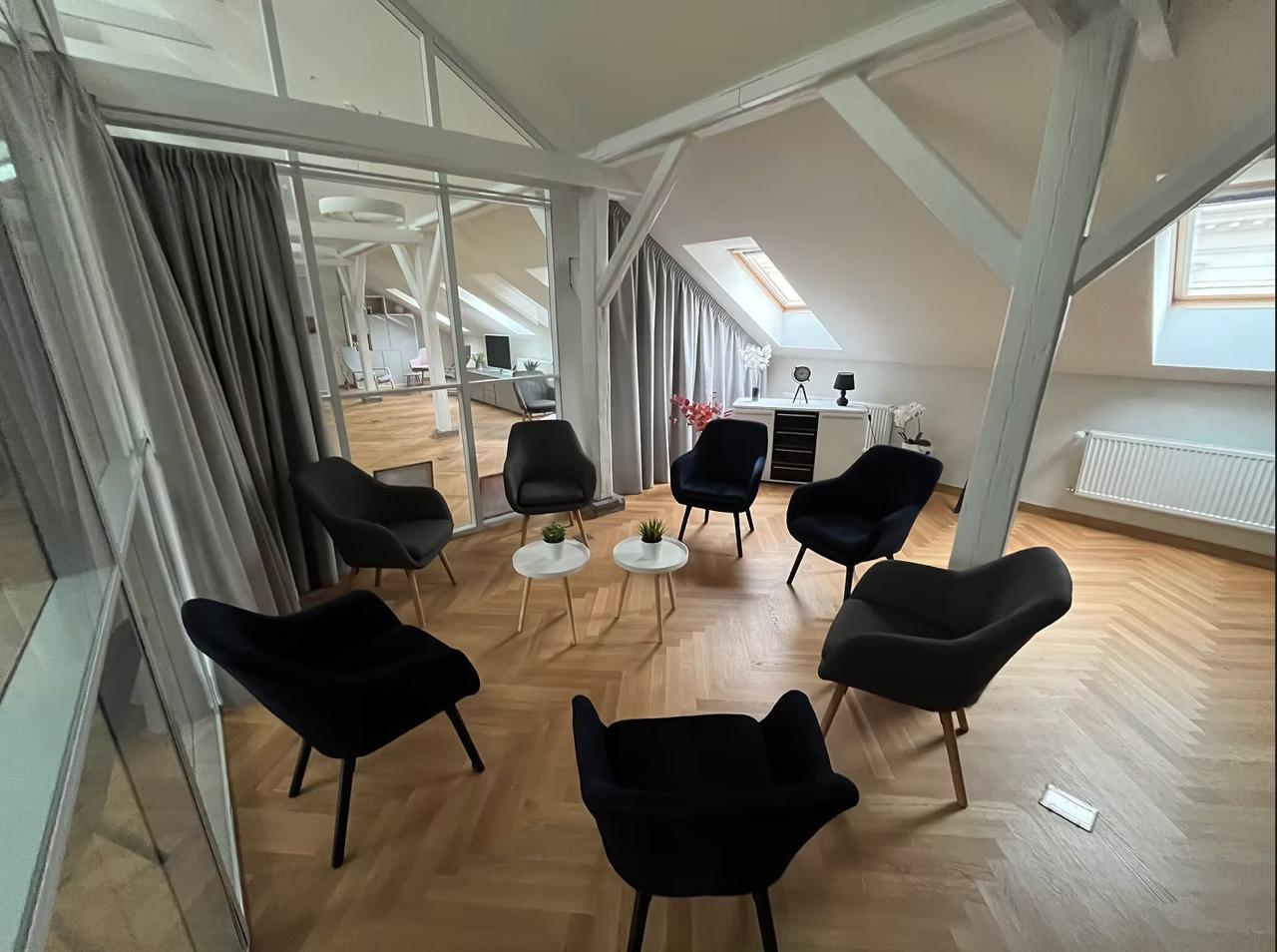
The program takes place in a pleasant and calm space in Prague, suitable for reflective group work.
SCHEDULE & INFORMATION
Schedule and terms of services
Participants can choose from one of four groups. The programme follows this terms.
3.11. · 10.11. · 24.11. · 1.12. · 8.12. · 15.12.
6.4. · 13.4. · 20.4. · 27.4. · 4.5. · 11.5.
5 Nov. · 12 Nov. · 26 Nov. · 3 Dec. · 10 Dec. · 17 Dec.
8. 4. · 15. 4. · 22. 4. · 29. 4. · 6. 5. · 13. 5.
Compass is not therapy. The program is designed for teenagers who are generally functioning well but want to gain greater clarity about themselves and their future direction.
If a teenager is experiencing significant psychological difficulties, therapy or professional mental health support may be more appropriate.
Compass focuses on:
Teenagers who:

About Martina Očadlíková
Martina Očadlíková is an ICF Professional Certified Coach (PCC).
She holds MBA and MSc degrees.
Before becoming a coach, she spent more than 15 years working in international business and leadership roles where complex decision-making and responsibility for people were part of everyday work.
In her coaching practice she helps clients recognise patterns in their thinking, communication, and decision-making and develop clearer and more constructive ways of approaching complex situations.
This structured approach is particularly valuable for teenagers who are beginning to face important life decisions.
Frequently Asked Questions
Who is Compass intended for, and who is it not suitable for?
Compass is designed for teenagers aged 16–19 who want to better understand themselves, their decisions, and their direction.
It is a safe and structured space for self-discovery, self-reflection, and building an „inner compass“ that helps young people make decisions more out of conviction than under external pressure.
The programme also draws on findings from developmental psychology regarding identity formation in adolescence, a period when it is natural to explore who I am and where I am heading.
Compass is not a substitute for therapy in acute psychological distress.
Is Compass also suitable for a teenager who isn't „in crisis“ but just wants to clarify their direction?
Yes, quite often that's when it's most valuable.
Compass is not an emergency intervention but a development programme. Its strength is also preventative: it helps young people gain clarity before they make big decisions.
How do I know if my daughter or son needs space to figure things out right now, rather than more advice?
If you hear „I don't know,“ you see hesitation, an overload of options, or a delay in making a decision, it's not necessarily a lack of information, but a lack of space to organise one's thoughts.
Today's teenagers often face what psychology calls The paradox of choice Too many options can lead to paralysis rather than freedom.
The compass helps to create criteria for making decisions.
Is the compass suitable for very capable and high-achieving teenagers under the pressure of expectations?
Yes, often precisely for them.
Many high-achieving young people aren't dealing with a lack of skills, but pressure, doubt, or making decisions under the expectations of others.
Kompas helps to build internal autonomy and confidence.
Can Compass help when my child doesn't know what they want to study or where to aim?
Yes.
It’s not just about choosing a school, but about developing the ability to make meaningful decisions.
Research shows that similar interventions strengthen decision self-efficacy, trust young people to make good decisions.
What if it's more about doubts, low self-confidence, or the fear of making the wrong decision?
Compass also deals with that.
Not only What to choose, but from what inner place am I making the decision.
That's often where healthy self-esteem begins.
How does Compass help you make decisions more for yourself and less according to others' expectations?
Helps to distinguish your own voice from external pressure.
This is one of the key tasks of adolescence and at the same time the core of identity development, upon which the programme is based.
How does Compass differ from career advice, mentoring, or standard coaching?
Fundamentally. Compass is not just about choosing a school or performance.
Connects
self-awareness
values
identity
• Decision-making
direction
It's not just about What to do, but Who I want to be.
Furthermore, it is based on the principles of evidence-based youth coaching, which is an established field abroad.
What specifically happens during the 12 weeks?
The programme combines a guided process, reflection, practical exercises, group dynamics, and the transfer of knowledge into everyday life.
It's not a theory, it's an experience.
The group format works by bringing together individuals facing similar challenges or goals. This shared experience creates a sense of community and understanding, making it easier for participants to open up and engage. The value lies in the collective wisdom and support. Members can share their perspectives, learn from each other's successes and failures, and gain new insights. This peer-to-peer learning is often more relatable and actionable than advice from a single expert. It also fosters accountability, as group members can encourage and motivate each other to stick to their commitments. The diversity of thought within a group can also spark innovative solutions that an individual might not have considered alone.
The group provides mirroring, courage, perspective, and the experience that one is not alone in matters of identity and decision-making.
And this often has more power than the advice of an adult.
What role do parents have in the process?
Parents are an important part of the context, but the programme space belongs to the teenager.
The aim is to support autonomy, not replace it.
What if my child feels resistant to the programme?
It's common.
Resistance is often resistance to control, not to growth.
Compass is not „managing a child“, but a space where they can think for themselves.
What will the participant take away long after the programme?
Not just clearer decisions now. Life skills:
self-reflection
greater self-confidence
• mental tools
• Resilience
the ability to make decisions even in uncertainty
Research into similar programmes also shows an impact on wellbeing, resilience, and motivation.
Why invest in Compass when there's a school, a psychologist, or career tests?
Similar programmes are becoming part of the modern standard of support for adolescents in the USA, Great Britain and Australia, as they respond to something very contemporary: the pressure of choices, uncertainty and the need for inner guidance.
Compass brings this approach to the Czech environment.
How do I know if Compass is more suitable than therapy?
Therapy treats problems.
Compass develops a person.
When it comes primarily to self-discovery, direction, and decision-making, it can be very suitable.
For more serious psychological difficulties, therapeutic support is more appropriate.
Registration
A place is reserved after completing registration and payment.
Participation in the programme is governed by the Programme Terms and the Privacy Policy.